Avocad Blog
AI vs Traditional Design for Ads: How to Choose the Right Workflow
Compare AI-generated and traditional ad design workflows by speed, cost, quality control, and risk so your team can choose the right model for each campaign.

Written by
Zihaan Mohamed- Reading time
- 4 mins
- Published
- April 26, 2026
- Last verified
- April 26, 2026
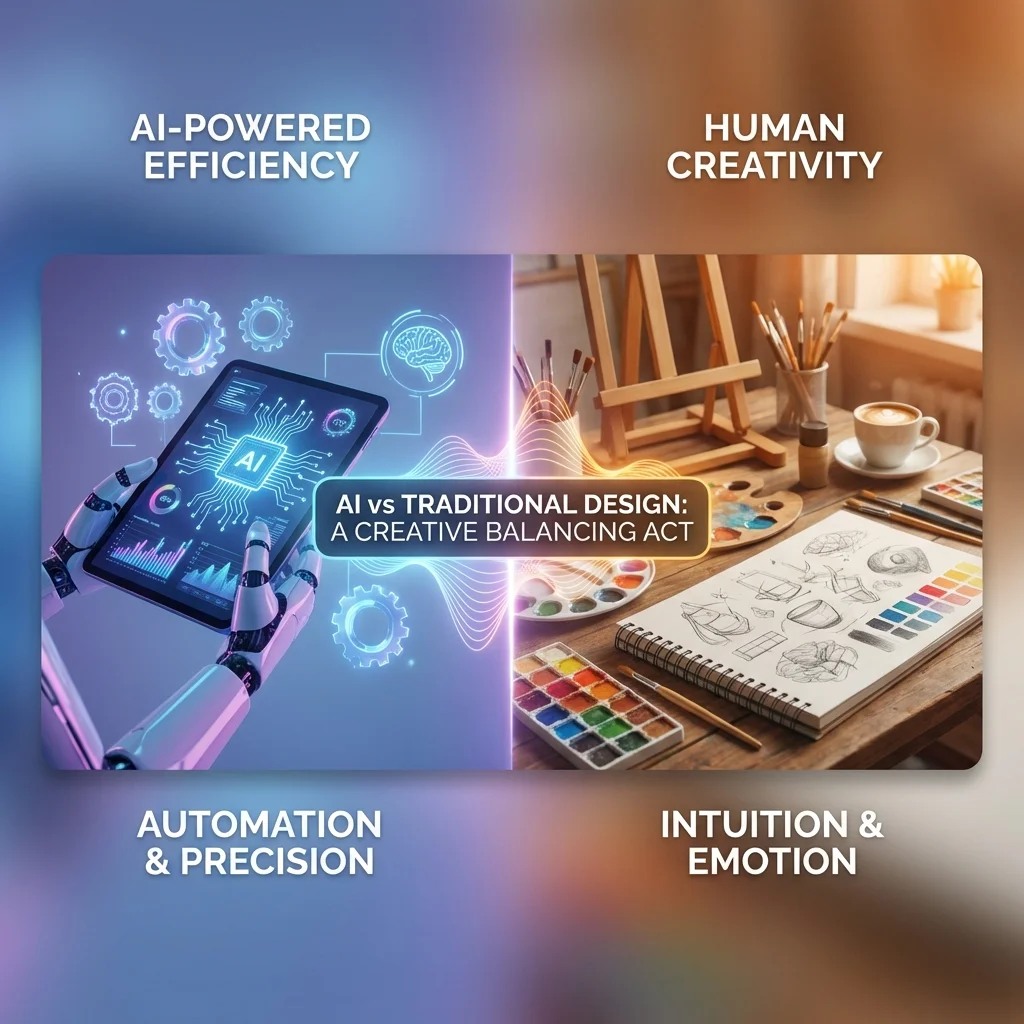
"AI vs traditional design" is the wrong question for most marketing teams.
The right question is:
"Which parts of this campaign should be automated, and which parts need human creative judgment?"
When teams frame it this way, quality goes up and production bottlenecks go down.
Quick Answer
- Use AI for: variant generation, resizing, format adaptation, first-draft exploration
- Use human design for: brand-defining concepts, strategic narratives, final quality control
- Use hybrid for: almost all performance marketing workflows
Where AI Is Strong Today
AI performs well when tasks are:
- repetitive
- high-volume
- constrained by clear inputs
Examples:
- generating 10 angle variants from one brief
- adapting creatives for multiple placements
- creating first-pass concepts for testing
If your team runs weekly ad iterations, this is where AI gives immediate leverage.
Where Traditional Design Still Wins
Human-led design remains stronger when tasks require:
- deep brand storytelling
- category nuance and cultural sensitivity
- cross-campaign art direction consistency
- high-stakes launches where originality matters
AI can help ideation here, but final direction usually needs an experienced creative lead.
The Real Tradeoff Matrix
| Dimension | AI-heavy workflow | Traditional workflow | Hybrid workflow |
|---|---|---|---|
| Speed | Very high | Medium to low | High |
| Cost per variant | Low | High | Medium |
| Strategic depth | Medium | High | High |
| Brand consistency risk | Medium to high (without controls) | Low to medium | Low |
| Scale across formats | High | Medium | High |
For most growth teams, hybrid is the best default.
Common Failure Modes in AI-Only Pipelines
- Visual sameness across campaigns
- Generic copy and weak positioning
- Inconsistent brand identity over time
- Unclear ownership and rights assumptions
These are process failures, not just model failures.
A Practical Hybrid Workflow
Stage 1: Human Strategy Brief
Lock:
- audience
- offer
- positioning angle
- success metric
Stage 2: AI Variant Production
Generate focused sets:
- offer-led
- proof-led
- urgency-led
Stage 3: Human Curation
Reject anything that fails brand fit, clarity, or policy checks.
Stage 4: Controlled Testing
Ship control + challenger only.
Stage 5: Learning Loop
Document winners and update briefs.
This method gives you speed without losing taste.
Governance and Risk Checklist
For teams scaling AI creative, maintain a lightweight governance layer:
- Versioned brand brief
- Approved asset library
- Claim guardrails and compliance checks
- Creative QA scorecard
- Documented ownership policy for outputs
Risk frameworks like NIST AI RMF are useful references when designing internal controls.
Rights and Ownership: What Teams Should Do
Copyright and AI guidance continues to evolve across jurisdictions. In the U.S., the Copyright Office provides ongoing guidance related to AI-assisted outputs and human authorship.
Practical policy for teams:
- Treat AI as an assistive tool, not an autonomous author.
- Keep records of human edits and decisions for final assets.
- Maintain source files and version history.
- Review platform terms for generated content usage.
This reduces legal uncertainty as policy continues to develop.
Cost Model: How to Think Clearly
Do not compare "AI tool price" to "designer salary" directly.
Compare full workflow cost:
- brief time
- production time
- revision rounds
- launch delay cost
- learning speed after launch
AI usually wins on throughput. Humans usually win on strategic precision. Hybrid wins on business outcomes in most performance contexts.
Decision Rules You Can Use Today
Use AI-heavy when:
- campaign goal is short-cycle testing
- brand system is already mature
- you need frequent creative refreshes
Use traditional-heavy when:
- launching a new brand identity
- running flagship campaigns
- working in sensitive categories with strict trust requirements
Use hybrid when:
- you need both speed and quality
- you have ongoing paid media spend
- you are optimizing weekly
Where Avocad Fits
Avocad is designed for the hybrid model.
Teams can use it to:
- convert strong briefs into multiple campaign-ready variants
- maintain visual consistency across placements
- reduce production lag between insight and launch
The key is to keep human review strict, especially for final copy, claim accuracy, and brand fit.
Related Guides
- Brand DNA Explained: How AI Reads Visual Identity for Better Ads
- Building Brand Consistency Across Multiple Platforms
- The Complete A/B Testing Guide for Small Business Ads
The winning model in 2026 is not AI-only or traditional-only. It is a disciplined hybrid system with clear ownership at each step.