Avocad Blog
The Complete A/B Testing Guide for Small Business Ads
A practical A/B testing system for small teams: clear hypotheses, clean test setup, reliable measurement, and repeatable creative wins.

Written by
Zihaan Mohamed- Reading time
- 5 mins
- Published
- April 26, 2026
- Last verified
- April 26, 2026
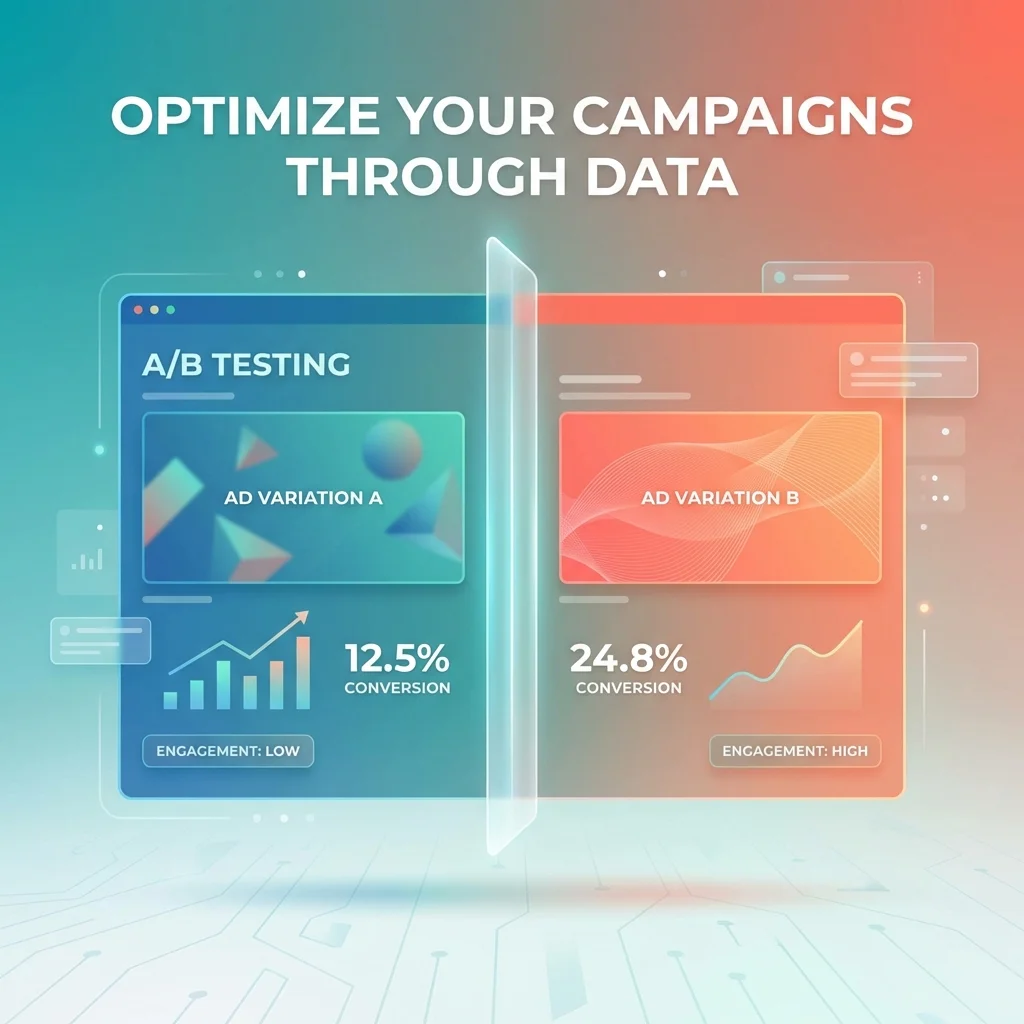
A/B testing is not about running two ads and hoping one wins.
It is a measurement discipline. If setup quality is low, you do not get insight. You only get noise.
This guide gives you a clean, repeatable system for small teams that want faster creative learning without wasting budget.
If you are new to weekly sprint execution, start with AI Ad Generation for Small Businesses: 30-Minute Ad Plan.
What Good A/B Testing Looks Like
A good test has five properties:
- One clear hypothesis
- One primary metric
- One variable changed
- Clean conversion tracking
- A pre-defined stop rule
Most "failed tests" are actually setup failures.
The Most Common Mistakes
- Testing headline, image, CTA, and audience all at once
- Changing budget mid-test without documenting it
- Declaring winners after one day
- Optimizing only for CTR while conversion quality drops
- Running tests without stable tracking tags
If you recognize these patterns, fix process first, then test volume.
Step 1: Write a Real Hypothesis
Bad hypothesis:
"Let us test two creatives and see what works."
Good hypothesis:
"For warm audiences, a social-proof headline will reduce cost per qualified lead versus an offer-led headline over a 7-day window."
A strong hypothesis includes:
- Segment
- Variable
- Expected direction
- Metric
- Time window
Step 2: Pick One Primary KPI
Use one decision metric per test.
Examples:
- Lead gen: cost per qualified lead
- E-commerce: cost per purchase
- App: cost per first key action
Secondary metrics still matter, but they should not override your primary decision unless there is a quality risk.
Step 3: Test One Variable at a Time
Keep everything else constant.
| Test type | Variable changed | Keep fixed |
|---|---|---|
| Message test | Headline angle | Visual, offer, audience, bid strategy |
| Visual test | Creative style or layout | Copy, offer, audience |
| Offer test | Discount, bundle, deadline | Visuals, audience, CTA |
| CTA test | CTA wording | Headline, visual, offer |
If you change more than one thing, you will not know what caused the result.
Step 4: Validate Tracking Before Launch
Before spending meaningful budget, verify that:
- Conversion events are firing correctly
- UTM structure is consistent (
utm_source,utm_medium,utm_campaign) - Destination URLs are correct
- CRM or analytics receives the right event names
For website campaigns, ensure your pixel/tag implementation is stable and tested.
Step 5: Use a Clear Test Window
A common small-team setup:
- Minimum test run: 5 to 7 days
- Avoid major edits mid-flight
- Pause only for policy issues or severe spend anomalies
If your daily volume is low, extend the window instead of forcing a decision early.
Step 6: Decide Using a Practical Rule Set
You do not need advanced statistics to improve outcomes, but you do need consistency.
Use this decision framework:
- Did Variant B beat Variant A on the primary KPI over the full test window?
- Is lead or purchase quality stable?
- Is the result direction consistent across at least 2 to 3 consecutive days?
- Was tracking intact throughout the test?
If the answer is yes to all four, promote the winner.
A Small-Budget Test Plan You Can Reuse Weekly
Monday
- Define one hypothesis
- Build control and challenger
- QA links and events
Tuesday to Friday
- Let test run
- Log daily spend, primary KPI, and one quality signal
Saturday
- Make decision
- Archive winner and loser with notes
Sunday
- Convert learning into next week's challenger
This simple cadence creates compounding gains over 4 to 8 weeks.
Test Log Template
Use one row per experiment:
| Field | Example |
|---|---|
| Test ID | 2026-W17-IG-STORY-HOOK |
| Channel | Instagram Stories |
| Audience | Warm retargeting 30d |
| Hypothesis | Proof-led hook lowers CPL |
| Variable | Headline |
| Primary KPI | Cost per qualified lead |
| Start/End | Apr 27 to May 3 |
| Winner | Variant B |
| What changed next | Apply proof-led opening to 2 new angles |
This log is more useful than any dashboard screenshot because it preserves decision context.
When to Use Platform Experiment Tools
If available, use native experiments for cleaner comparisons.
For Google Ads, Experiments can split traffic and compare variants under controlled conditions. Similar controlled workflows exist across major ad platforms.
Even with platform tools, your hypothesis and tracking discipline still determine test quality.
Creative Angles Worth Testing First
Start with high-leverage variables:
- Offer-led vs proof-led headline
- Product close-up vs problem/solution visual
- Direct CTA vs low-friction CTA
- Static image vs short-form video
Run these before trying niche design tweaks.
Quality Guardrails So You Do Not Optimize the Wrong Thing
Use fail-safe thresholds. Example:
- If CPL improves but qualification rate drops sharply, do not scale yet.
- If CTR is high but landing conversion collapses, investigate message mismatch.
- If ad comments indicate confusion, fix clarity before spending more.
A winner is only a winner if business quality holds.
Where Avocad Helps This Workflow
Avocad is strongest in the variant production stage.
Use it to quickly generate controlled challengers based on one angle shift per test, then review with a strict scorecard before launch.
Recommended sequence:
- Write hypothesis
- Define one variable
- Generate two to four focused variants
- Launch only two clean versions (control + challenger)
- Log outcome and feed learnings into next sprint
Related Guides
- Writing Ad Copy That Converts: A Data-Driven Guide
- Your First Ad Campaign: A Step-by-Step Launch Guide
- Building Brand Consistency Across Multiple Platforms
The goal is not to run more tests. The goal is to run fewer, cleaner tests that produce decisions your team can trust.